Description
Video (short v2 demo), Discord (questions and support), Documentation
Overview
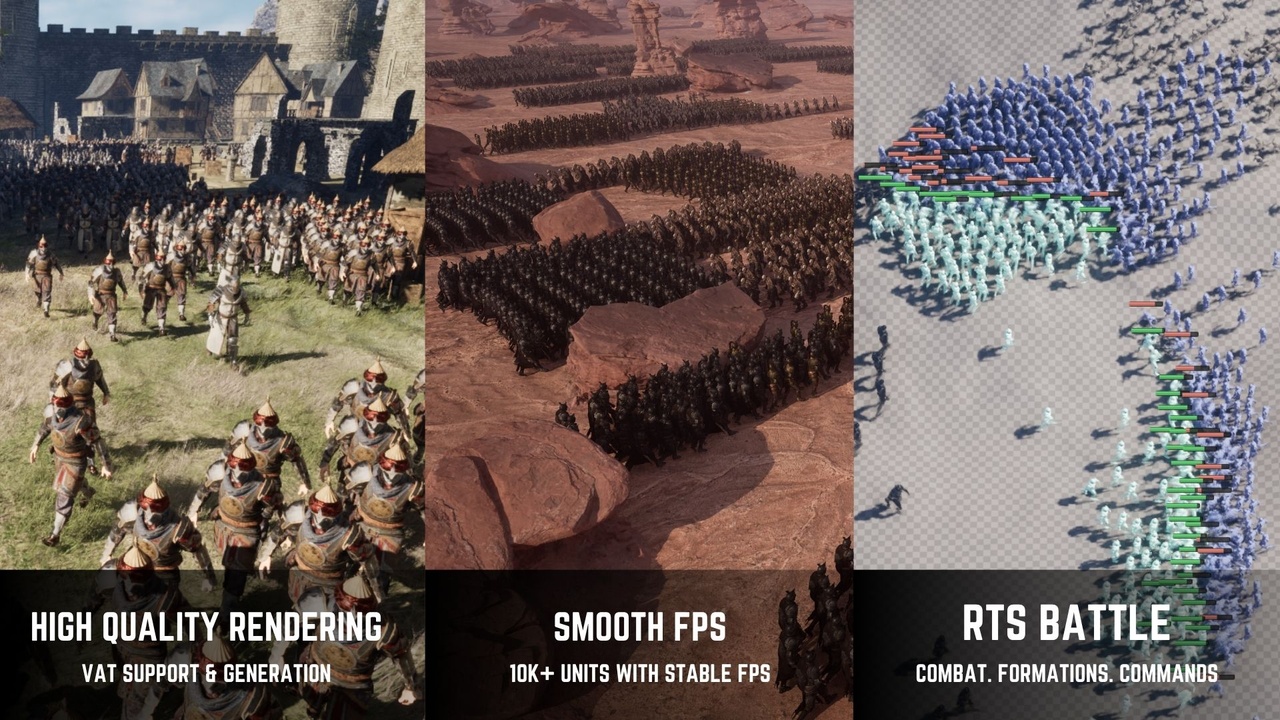
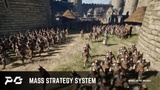
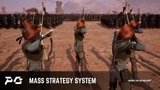
Pioneer Mass Strategy System is a high-performance, data-oriented foundation for building RTS, top-down strategy, and large-scale combat games in Unreal Engine. Built on Unreal’s Mass Entity framework, Pioneer gives you the core systems out of the box: large-unit navigation, selection, commands, combat, formations, rendering, and animation, so you can focus on your own units, factions, maps, and game rules.
Core Features
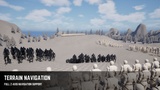
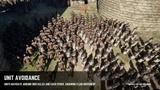
Mass unit navigation with navmesh-based pathfinding, avoidance, steering, confinement, and sleep optimization
Melee and ranged combat with health, armor, teams, target acquisition, projectiles, damage, and death handling
Groups and formations with control slots, group recall, merge, ungroup, and built-in formation layouts
Command queue so players can plan multi-step orders
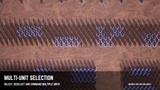
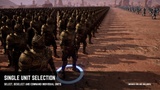
Unit selection and commands including click selection, drag selection, move, attack move, attack, hold position, stop, patrol, follow, retreat, and charge
Actor-Mass Bridge so regular Unreal Actors and Mass entities can fight side by side
Mass unit animation states for idle, walk, run, charge, attack, and death using baked vertex animation data
Efficient rendering through Instanced Static Mesh support, dynamic LOD, and vertex animation workflows
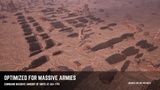
Large unit counts with tested support for up to 10,000 units on suitable hardware and map setups
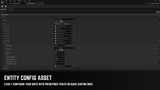
Entity Config Assets for creating unit types through reusable traits
What You Can Build
RTS and top-down strategy games
Large-scale battle simulations
Wave-based enemy games
Hybrid games with Actor heroes or squads fighting Mass armies
Strategy prototypes with selection, movement, formations, combat, and UI already connected
Included Sample Modes
RTS Mass Battle
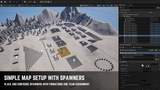
A large-scale RTS battle starting point with deployment, command cards, groups, formations, melee units, ranged units, projectiles, match state, and HUD.
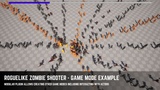
Top Down Zombie Shooter
A squad-action sample where Actor operatives fight Mass zombie entities through the Actor-Mass Bridge. This is useful if your project needs a smaller number of detailed Actor characters fighting many Mass enemies.
Updates
Version 4.2
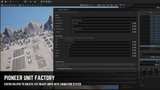
Per-slot master materials in Unit Factory: You can now assign a different VAT-capable master material per static-mesh material slot
Version 4.1
Defensive move behavior: Move orders now stay focused on their destination while still letting units defend themselves against immediate nearby threats
Version 4.0 - Combat Update
Two new sample game modes: RTS Mass Battle and Top Down Zombie Shooter
Melee and ranged combat for Mass entities
Projectile simulation with direct, ballistic, and lobbed trajectory options
Actor-Mass Bridge for combat between regular Unreal Actors and Mass entities
Group and formation system with control slots
Command queue for multi-step orders
New Mass animation system for locomotion, charge, attack, and death states
New combat-ready unit examples and zombie enemy examples
Version 3.1
Improved performance: Consolidated navigation processors, improved use of cached data and simplified obstacle querying
Version 3.0
Terrain navigation: Units can now walk on Z-Axis based on navigation mesh data
Animation blending
Version 2.0
Instanced Static Mesh (ISM) support for units
You can now render up to 10,000 units on screen while maintaining smooth and stable FPS
Dynamic LOD system
Foliage support with navigation mesh
Vertex animation setup
Free camera mode
Performance Notes
Pioneer is built for large unit counts, but performance depends on hardware, map complexity, navmesh complexity, unit setup, animation cost, combat density, and how many systems are active at once.
The 10,000-unit target was tested on:
AMD Ryzen 9 7900X 12-Core Processor
NVIDIA GeForce RTX 4070
32 GB RAM
Before You Buy
Pioneer is mainly a C++ project built on Unreal's Mass Entity framework. C++ knowledge and a basic understanding of Mass Entity are required if you want to integrate the system deeply into your own project or add custom gameplay logic. Without C++ knowledge, you can still use and adjust included content such as units, buildings, resources, maps, data assets, and some Blueprint-facing setup. However, advanced custom behavior is difficult to build only in Blueprints because most runtime data lives in Mass fragments and most core logic is implemented in C++.
The included game modes are starting points and examples, not complete shipped games. They are intended to show how the systems fit together and give you a practical base to customize.
Required Plugins
CommonUI