Description
Design the Adventure, Not Just the Floor Plan
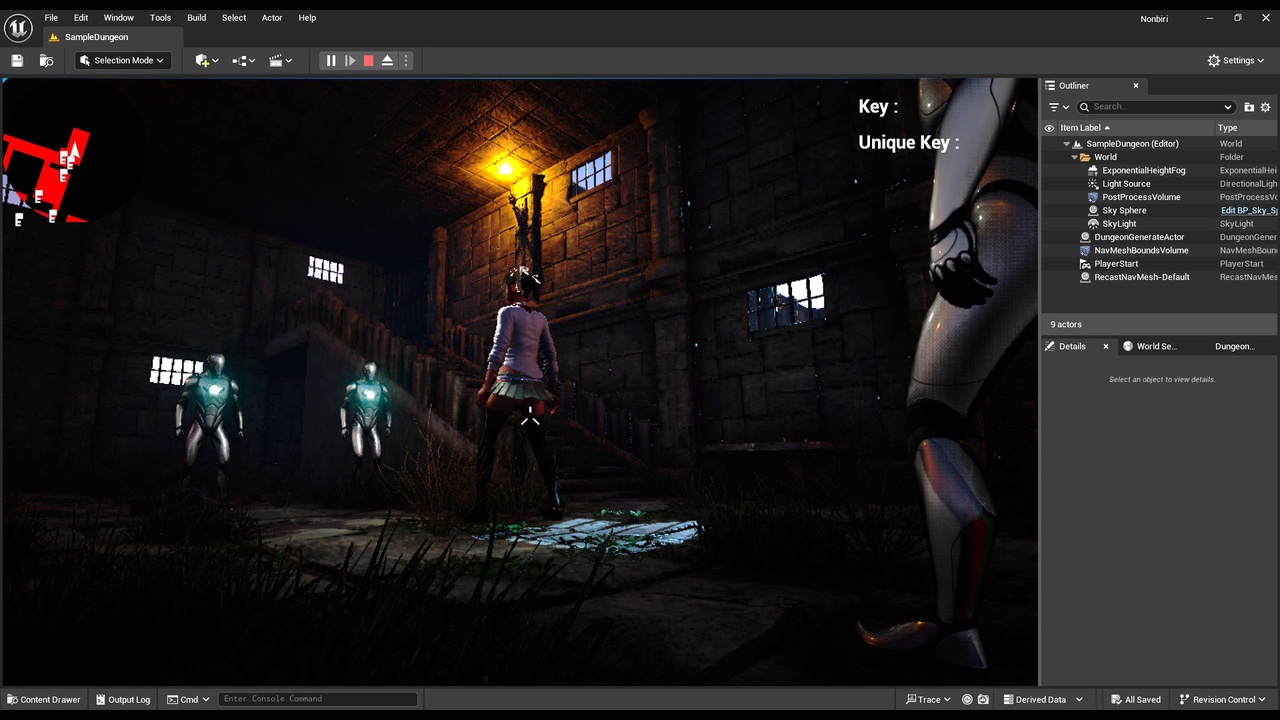
Dungeon Generator is a C++ plugin for Unreal Engine 5 that creates replayable, multi-floor 3D dungeons from your own modular meshes.
Choose how the dungeon should play—open exploration, a clear route from start to goal, keys and locked doors, progression toward a boss, or objectives branching from a hub. Then customize its structure, visual themes, room purposes, interiors, and runtime behavior.
Dungeons can be generated in the editor or at runtime. The plugin provides both Blueprint and C++ APIs, allowing generated rooms and routes to drive enemies, rewards, events, doors, maps, and other gameplay systems.
Important — Version 2.0 is not backward-compatible with Version 1.x
Automatic migration, in-place upgrades, and asset conversion from v1.x are not supported. Do not install v2.0 over a working v1.x project. Keep your v1.x project and matching plugin version, and configure v2.0 separately.
v1.x Dungeon Generator assets, parameters, Blueprint integrations, C++ integrations, fixed seeds, and generated layouts must be recreated or adapted manually.
Shape How the Dungeon Plays
Select one of five Progression Policies as the starting point for your level design:
Free Exploration — Loops, shortcuts, and optional side rooms
Start to Goal — A readable main route with controlled branches
Keys and Locks — Keys unlock progression routes that cannot be bypassed
Boss Route — Encounters and rest areas build toward a boss room
Hub Quest — An early hub connects to multiple objective-style branches
The generator evaluates multiple layout candidates and selects the result that best matches your chosen design intent. Room counts, sizes, floors, branches, loops, corridor complexity, and other details remain adjustable.
Give Every Area a Purpose
Gameplay Roles describe why a generated room exists:
Combat
Treasure
Puzzle
Rest
Boss
Secret
Use these Roles through Room Sensors, Blueprint, or C++ to connect generated rooms to your own enemies, rewards, puzzles, events, and game rules.
Zones can be selected by dungeon progress and floor. Each Zone or Gameplay Role can override visual and gameplay settings, helping entrances, deeper areas, upper floors, boss rooms, and secret areas feel distinct.
Gameplay Roles provide level-design information; they do not force a specific combat, treasure, or puzzle system.
Features
Multi-floor tiled dungeon generation in the editor and at runtime
Five designer-friendly Progression Policies
Branches, loops, shortcuts, secret rooms, keys, and locked routes
Multi-candidate layout evaluation
Gameplay Roles and structural room information
Zone-based visual and gameplay overrides
Support for your own floor, wall, ceiling, slope, pillar, door, and Actor assets
Authored special rooms using sub-levels
Procedural interior, fixture, and vegetation placement
Customizable Mesh Set and Parts selection through Blueprint or C++
Static Mesh Fit Tool for adapting meshes to the dungeon grid
HUD minimap and exploration-map support
Room, player, key, door, and custom map icons
Runtime load controls for Actors, AI, collision, Tick, lights, and activation limits
Multiplayer-oriented generation using a replicated seed and CRC validation
Generation diagnostics with issue codes, explanations, and suggested fixes
Sample maps and beginner-friendly documentation included
Workflow
Add a Dungeon Generate Actor to your level.
Create a Dungeon Generate Parameter Asset.
Assign your meshes and generation databases.
Choose a Progression Policy.
Adjust Structure, Path, Zones, Theme, and Gameplay settings.
Preview the result in the editor or generate it during gameplay.
Related settings are organized into clear groups, making it easy to start with the essentials and fine-tune the dungeon later.
Videos and Documentation
- Trailer: YouTube
- Tutorial Videos: YouTube Playlist
- Documentation: Tutorial Index
- v1.x and v2.0 Comparison: Migration and Feature Guide
- Support and Discussions: GitHub Discussions
Dungeon Generator is designed for roguelikes, action RPGs, dungeon crawlers, exploration games, escape games, and projects that need replayable spaces without giving up control over progression or visual identity.